
What Happens If You Encounter a Komodo Dragon in the Wild?
Imagine walking along a dry savanna trail on a remote Indonesian island when you suddenly spot a Komodo dragon just a few meters away. Its powerful legs, sharp claws, and flickering forked tongue make it clear that this is not an ordinary wildlife encounter.
For many travelers, seeing a Komodo dragon in its natural habitat is a once-in-a-lifetime experience. These remarkable reptiles are native to several Indonesian islands, including Komodo, Rinca, and parts of Flores. Komodo National Park is one of the world’s best-known destinations for observing them in the wild.
But what should you do if you encounter one unexpectedly? Are Komodo dragons dangerous to humans? Should you run away, remain still, or follow a ranger’s instructions?
Understanding their behavior and respecting wildlife safety rules can help you enjoy this extraordinary experience responsibly.
In this guide, we explore what happens during a potential encounter with a Komodo dragon, how to respond safely, and where to discover the wildlife and culture of Parc National De Komodo.
Are Komodo Dragons Dangerous to Humans?
Yes. Komodo dragons are wild predators capable of inflicting serious injuries on humans. Although they do not attack every person they encounter, they must always be treated with caution.
Adult Komodo dragons can reach approximately three meters in length, although their size varies. They have muscular bodies, strong limbs, sharp claws, and serrated teeth adapted for capturing and tearing prey.
Their hunting abilities are more complex than many visitors realize. Komodo dragons use their keen sense of smell to locate food, including deer and wild pigs. They may remain motionless for extended periods before moving toward potential prey.
Their bites are particularly dangerous because they can cause deep wounds and severe bleeding. Komodo dragons also possess venom that can interfere with blood clotting and blood pressure, potentially contributing to serious complications.
However, encountering a Komodo dragon does not automatically mean an attack will occur. The animal may continue resting, move through its habitat, or react to its surroundings in ways that visitors cannot easily predict.
The most important rule is to respect the animal’s space and never assume that it is harmless simply because it appears calm.
What Should You Do If You Encounter a Komodo Dragon?
If you encounter a Komodo dragon in the wild, your priority should be to avoid provoking it and follow the instructions of your authorized park ranger or naturalist guide.
Here are five essential safety principles to understand before visiting Komodo National Park.
1. Stay Calm and Listen to Your Ranger
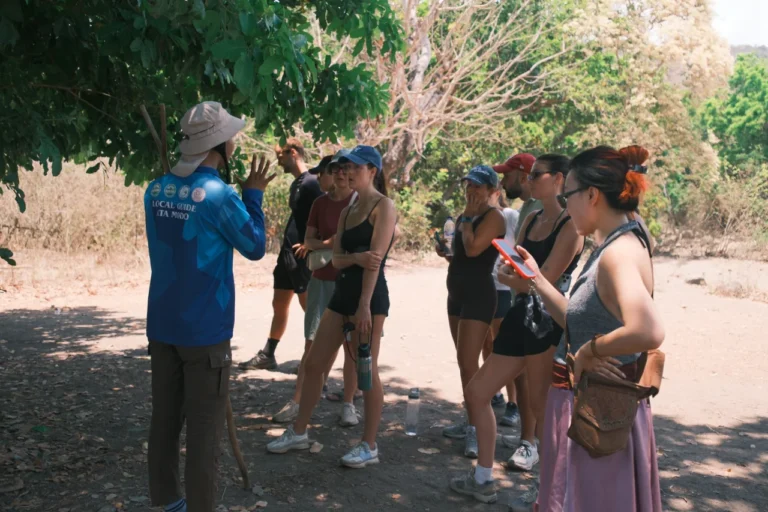
Seeing a large predator unexpectedly can be frightening, especially if you have never encountered one before.
Avoid shouting, making sudden movements, or attempting to get closer for a better photograph. Listen carefully to your ranger, who can assess the situation and guide your group appropriately.
Rangers are familiar with the local environment and help manage encounters between visitors and wildlife. Their instructions should always take priority over your desire to take photographs or continue along a particular trail.
If your ranger asks your group to stop, change direction, or leave an area, follow those instructions immediately.
2. Maintain a Safe Distance
Never approach a Komodo dragon simply because it appears to be resting or ignoring you.
These animals can move unexpectedly, and their apparent lack of interest should not be interpreted as a guarantee of safety. Keep the distance specified by your ranger and allow the animal enough space to move naturally.
Avoid standing directly in its path, surrounding it with other visitors, or positioning yourself between the animal and its direction of movement.
A photograph taken from a safe distance is always preferable to risking an unsafe encounter for a close-up shot.
3. Never Touch, Feed, or Provoke a Komodo Dragon
Feeding or teasing wildlife can create dangerous situations for both people and animals.
Do not offer food, throw objects, attempt to attract the dragon, or use anything to provoke a reaction. Such behavior can interfere with natural wildlife behavior and create unnecessary risks.
Follow the national park’s visitor regulations and respect instructions from authorized personnel.
Responsible wildlife tourism means observing animals without interfering with their lives.
Komodo National Park contains rugged hills, dry savannas, forests, and coastal habitats. Exploring these environments without guidance can expose visitors to risks they may not recognize.
Stay with your group and follow the designated trekking route. Do not wander away to photograph an animal, explore an isolated area, or search for a better viewpoint.
Your ranger can help you understand the surroundings and respond appropriately when wildlife is nearby.
5. Never Attempt a Close-Up Selfie
Photographing a Komodo dragon can be one of the highlights of your trip, but a close-up selfie is not worth the risk.
A resting dragon may look peaceful, yet its behavior can change without an obvious warning. Camera angles can also make an animal appear farther away than it really is.
Use a zoom lens when possible, remain at the distance specified by your guide, and prioritize the safety of everyone in your group.
The best wildlife photographs are those taken without disturbing the animal or putting the photographer in danger.
What If a Komodo Dragon Starts Moving Toward You?
A Komodo dragon moving in your direction does not necessarily mean it is preparing to attack. It may simply be traveling through its habitat.
Nevertheless, do not try to interpret its intentions yourself.
If you are on a guided walk, stop following your own instincts and pay attention to your ranger’s directions. Depending on the circumstances, the ranger may instruct your group to remain still, change position, or leave the area.
Do not approach the animal to test its reaction, attempt to distract it, or make sudden movements in an effort to get past it.
If you encounter a Komodo dragon unexpectedly without a guide, do not approach or attempt to handle it. Avoid provoking it, increase your distance if you can do so safely, and contact park personnel for assistance as soon as possible.
There is no universal maneuver that guarantees safety in every encounter. The animal’s position, behavior, surroundings, and available escape routes all matter.
This is one reason ranger-guided wildlife observation is so important when exploring Komodo dragon habitat.
What Should You Do If a Komodo Dragon Bites Someone?
A Komodo dragon bite is a medical emergency. Its teeth can cause deep wounds, and venom-related effects may contribute to severe bleeding and other complications.
If someone is bitten, prioritize emergency assistance rather than trying to continue the tour.
- Alert the ranger immediately. Inform park personnel and request emergency assistance.
- Move away from further danger. Follow the ranger’s directions and avoid approaching the animal again.
- Control the bleeding. If it is safe to help, apply firm, direct pressure to the wound using a clean dressing or cloth.
- Arrange urgent medical care. The injured person needs professional assessment and appropriate treatment as quickly as possible.
Do not attempt to capture the dragon, inspect its mouth, or treat the injury as a minor animal bite. Do not delay medical attention while waiting to see whether symptoms develop.
Although serious incidents are not an inevitable part of visiting Komodo National Park, knowing how to respond can make a critical difference in an emergency.
Why Are Rangers Important in Komodo National Park?
Rangers play an essential role in protecting both visitors and Komodo dragons.
They help visitors navigate designated trails, explain local wildlife, communicate safety instructions, and manage encounters with animals. Their knowledge of the terrain and park regulations is particularly important in an environment where wildlife must remain undisturbed.
Visiting with an authorized guide also helps ensure that travelers understand how to behave around the animals rather than relying on assumptions or information from social media.
Komodo dragons are not zoo animals. They live in a protected natural environment where their behavior cannot be controlled for visitors’ convenience.
For that reason, choosing a responsible tour operator and following the park’s requirements are essential parts of planning a wildlife experience.
Where Can You See Komodo Dragons in the Wild?
Komodo dragons are native to several Indonesian islands, including Komodo, Rinca, Flores, Gili Motang, and Nusa Kode.
For travelers visiting the region, Komodo National Park offers opportunities to learn about these reptiles, their habitat, and the conservation efforts that help protect them.
Three places worth understanding are Loh Liang on Komodo Island, Loh Buaya on Rinca Island, and Kampung Komodo, a local settlement on Komodo Island.
Each provides a different perspective on the area’s wildlife, landscape, and human communities.
Frequently Asked Questions
Can you walk near Komodo dragons safely?
Visitors can observe Komodo dragons on authorized, ranger-guided walks when they follow park rules and maintain the distance specified by their guide. However, no wildlife encounter is completely risk-free.
Do Komodo dragons attack tourists?
Komodo dragons can seriously injure humans, but an attack is not inevitable whenever a person encounters one. Their behavior can be unpredictable, which is why visitors must not approach or provoke them.
Should you run if you see a Komodo dragon?
Do not rely on running as a safety strategy. Avoid provoking the animal, follow your ranger’s directions, and move away only as directed and when it is safe to do so. The appropriate response depends on the circumstances.
Can you take photos of Komodo dragons?
Yes, photography is possible when permitted and conducted from a safe distance. Follow your ranger’s instructions and never approach an animal for a selfie.
Is it safe to visit Komodo National Park?
A visit can be managed responsibly by following park regulations, using authorized guides where required, and respecting wildlife. Visitors must still recognize that Komodo dragons and the surrounding natural environment present genuine risks.
What happens if you encounter a Komodo dragon without a ranger?
Do not approach, feed, or provoke the animal. Avoid unnecessary movement toward it, increase your distance if you can do so safely, and contact park personnel for assistance. Never attempt to handle or capture the dragon.
Can you see Komodo dragons at Kampung Komodo?
Komodo dragons inhabit parts of Komodo Island, but sightings within Kampung Komodo are not guaranteed. Visitors should not approach animals independently and should follow guidance from authorized personnel.
What is the difference between Loh Liang and Loh Buaya?
Loh Liang is a major visitor area on Komodo Island, while Loh Buaya is a visitor area on Rinca Island. Both offer opportunities for guided wildlife observation, but they are located on different islands and have distinct trekking routes and surroundings.
 English
 Español
 Bahasa Indonesia
 Français
 Deutsch