
From the Ancient Mount Samalas to Mount Rinjani: A Mountain Whose History Changed the World and a Philosophy that Preserves Culture
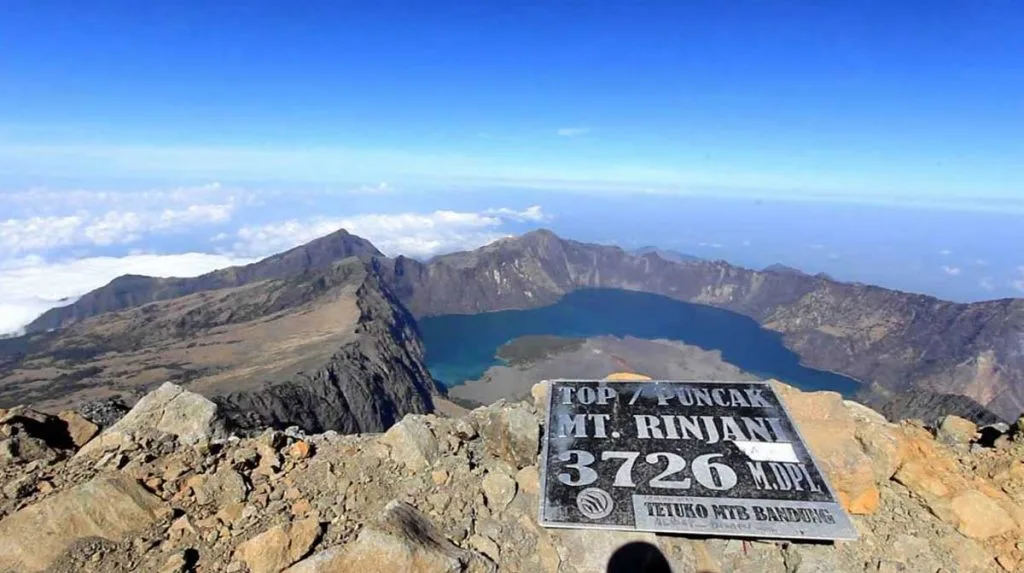
Mount Rinjani stands at 3,726 meters above sea level, making it one of Indonesia’s active volcanoes located along the Ring of Fire. Its most recent eruption occurred in 2009.Among hikers and nature lovers, Rinjani is famous for its extraordinary natural beauty, making it one of the most sought-after climbing destinations in Indonesia.
The Origin of Mount Rinjani
Rinjani is believed to originate from the name Rara Anjani, which later evolved into Renjani, and eventually transformed into Rinjani. Related to the name Rara Anjani, in East Lombok there is a village called Anjani Village.
Likewise, a convention hall in Mataram is named Gedung Dewi Anjani. This reflects how deeply the community respects and honors this name, even though many no longer fully believe in the myth, according to Herman et al. (1990/1991:48) cited by the Indonesian Language Development and Fostering Agency, Ministry of Education and Culture.
The Geology of Mount Rinjani
According to the Ministry of Energy and Mineral Resources, the main morphology of Rinjani consists of a caldera and volcanic cones. The caldera is elliptical in shape with slopes ranging from 60–80 degrees. Its base rocks consist of lava and pyroclastic deposits.The volcanic cones occupy the inner part of the caldera and its walls, including Mount Barujari, Mount Rombongan, Mount Rinjani, and Mount Manuk. Their slopes range from 30–70 degrees, with radial drainage patterns, and their base rocks are primarily pyroclastic deposits.
Meanwhile, high hill morphology and low undulating ridge morphology are located in the eastern, western, and upper slopes of the Rinjani complex. These areas are characterized by steep cliffs with slope angles between 30–80 degrees and gentler slopes under 30 degrees.
The Revealed History: The Eruption of Ancient Mount Samalas That Became Mount Rinjani
From Sembalun Lawang Village, East Lombok, Mount Rinjani rises majestically against the blue sky of Lombok Island. At its foothills stretch rolling hills covered with savanna grass mixed with brown earth, forming a dramatic landscape.
Behind this beauty lies a tragic ancient memory passed down through generations: the catastrophic eruption of Mount Samalas in 1257, which destroyed settlements and forced residents to flee across Lombok Island.
This tragedy is recorded in the ancient manuscript Babad Lombok, written on palm leaves. It tells how Mount Samalas raged for seven days:
“Mount Rinjani collapsed and Mount Samalas fell apart. Floods of rocks thundered, destroying Pamatan Village. Houses collapsed and were swept away by mud into the sea. Many people died For seven days, massive earthquakes shook the earth. People ran; some fled to the hills.Refugees scattered to Jeringo, Samulia, Borok, Bandar, Pepumba, Pasalun, Serowok, Piling, Ranggi, Sembalun, Pajang, Sapit, and many other areas.All fled with their queen and rebuilt their lives after the earthquakes ended.”
Some survivors migrated through Pilin Forest in Sambalia toward Labuan Lombok and Selaparang, where their descendants lived for centuries before eventually returning to Sembalun, forming what is now known as Sembalun Period II.Unfortunately, no written local records remain—only oral traditions passed down through generations.
Scientific Research Reveals the Mystery of Mount Samalas
The mystery of Samalas was scientifically confirmed when volcanologist Franck Lavigne and an international research team published a paper titled:
“Source of the Great A.D. 1257 Mystery Eruption Unveiled, Samalas Volcano, Rinjani Volcanic Complex, Indonesia”
in the Proceedings of the National Academy of Sciences (PNAS) on October 15, 2013.
The study concluded that the massive 1257 eruption originated from Mount Samalas, part of the Rinjani volcanic complex. This discovery solved a decades-long mystery among volcanologists and climate scientists.
The eruption caused global climate anomalies—extreme cold, continuous rainfall, crop failures, famine, and disease outbreaks. Archaeologists in England even linked a mass grave in London to the climate disaster of 1258.
The Fury of Samalas That Changed the World
Rinjani’s history is not merely about a mountain, but about an ancient giant, Mount Samalas, once towering over 4,000 meters.
- The Cataclysmic Eruption of 1257 (VEI-7)
One of the largest eruptions in the past 7,000 years.
Volcanic material caused a “Year Without Summer” in parts of the world.
Crop failures and famine spread globally.
- The Collapse of Pamatan Civilization
The prosperous Kingdom of Pamatan was buried beneath pyroclastic material, similar to Pompeii in Italy.
Survivors formed the roots of modern Sasak communities.
- The Birth of Rinjani
The collapse formed a massive caldera that filled with water, creating Segara Anak Lake.
A new peak emerged: Mount Rinjani (3,726 m).
Ongoing volcanic activity formed Mount Barujari in the middle of the lake.
Eruption History of Mount Rinjani
Rinjani’s activity is divided into three phases: before caldera formation, during caldera formation, and after.
Recorded eruptions occurred between 1847 and 2009, totaling 11 eruptions, mostly producing lava and pyroclastic materials. Significant activities were documented in 1846, 1884, 1901, 1906, 1915, 1944, 1966, 1994, 2004, and 2009.
The 2009 eruption produced thick brown ash reaching 1,000 meters above the crater at Mount Barujari, accompanied by lava flows entering Segara Anak Lake.
Rinjani and Its Spiritual Touch
Mount Rinjani is a dream destination for hikers. At 3,726 meters, it is the second-highest active volcano in Indonesia and part of the Seven Summits of Indonesia.
There are six official hiking routes: Senaru, Torean, Timbanuh, Aik Berik, Tetebatu, and Sembalun. The Sembalun route is the most popular due to its gentle terrain and stunning savanna landscapes. Each trail offers unique challenges and unforgettable sensory experiences
Why Rinjani?
Rinjani is the ultimate dream mountain for climbers visiting Lombok. Known as the roof of West Nusa Tenggara, it offers a complete adventure package: hills, hot springs, vast savannas, fishing in Segara Anak Lake, breathtaking views, and rare wildlife such as the Rinjani scops owl.
Rinjani is not merely about conquering a summit. It teaches simplicity, gratitude, and respect for nature.
Whatever happens, Rinjani is waiting for you.
 English
  Español
  Bahasa Indonesia
  Français
  Deutsch